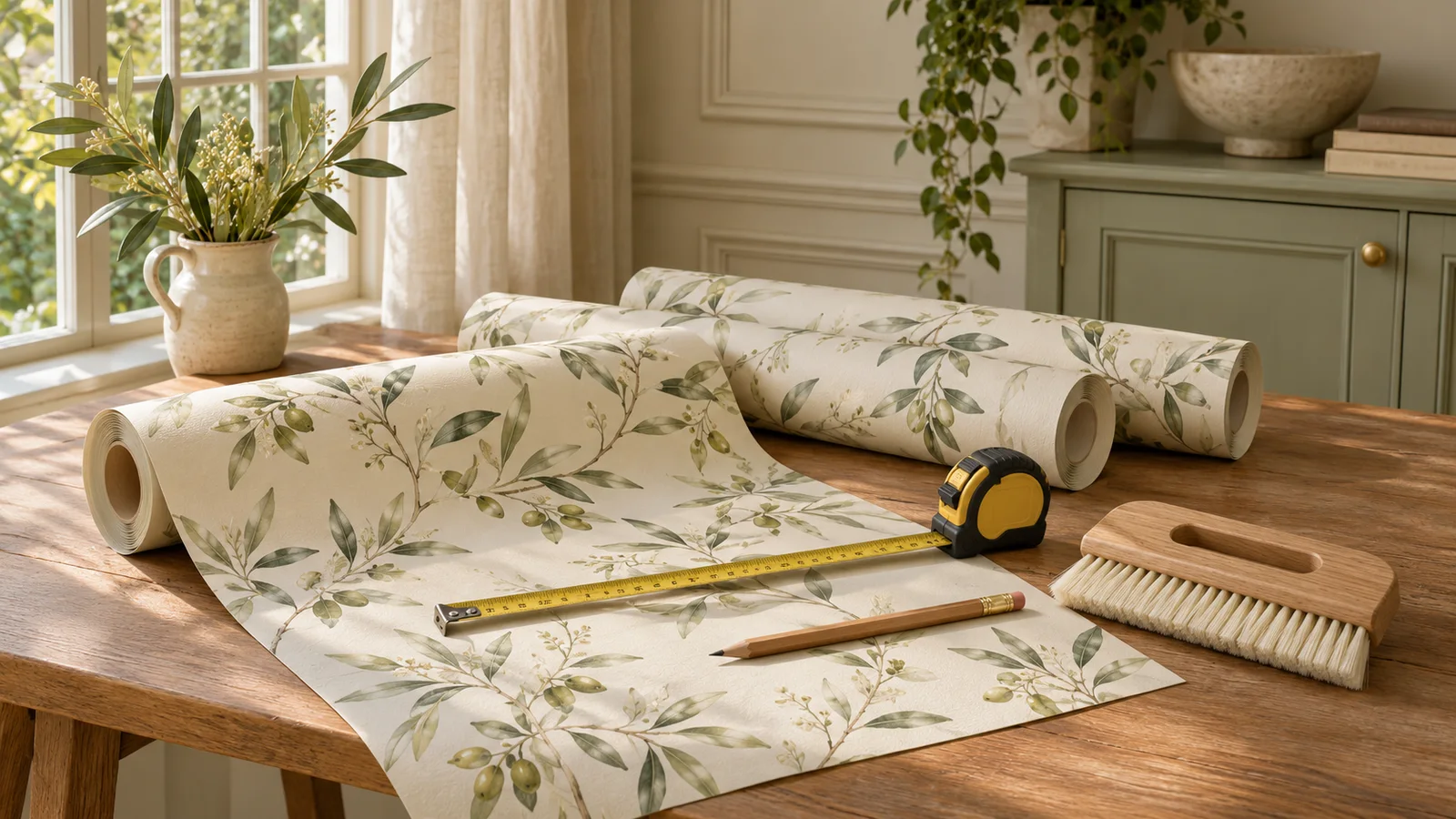
Quick answer: Drops needed = the sum of each wall width divided by roll width, rounded up per wall. Rolls needed = drops, with your extra buffer, divided by full drops per roll, rounded up. A 12 ft accent wall at 8 ft high needs 3 double rolls with a 21 in straight repeat, 4 in trim and a 10% buffer; 4 with one spare.
Calculation and source review: Live Decor Well · . Conservative planning estimates, not a guaranteed installer cutting schedule.
How to use the wallpaper calculator
Choose full room, accent wall or panels, then enter your wall measurements and the product dimensions from its label. Add the repeat, match type and trim allowance. Review the strip count, apply an extra buffer if needed, and check the physical roll or panel price before ordering.
1. Measure each wall separately and use the tallest point for the shared height. For a sloping ceiling, this gives a conservative estimate rather than an optimized shape layout.
2. Enter the actual roll width and length. In panel mode, use the usable width after any required overlap and confirm the panel is long enough.
3. Copy the repeat and match type from the label. Start with about 4 inches (10 cm) total trim per drop, or the amount your manufacturer requires.
4. Check the results, then download or print your shopping list. The spare is shown separately from the extra percentage buffer.
Source: York Wallcoverings installation guide for per-strip trimming and product-specific instructions.
How many rolls of wallpaper do I need?
Count whole strips across each wall and divide their total by the full-length strips obtainable from your chosen roll. Round up only after applying any extra buffer. Wall area is a useful comparison, but it cannot tell you whether a leftover piece is long enough to finish another full drop.
The quick area calculation is net wall area × (1 + buffer) ÷ gross roll area, rounded up. A rough 15% allowance is sometimes used for an initial budget, but it cannot replace repeat-specific cutting math. This tool uses your chosen buffer for both methods so the comparison is consistent.
Doors and windows reduce only the area comparison. Their upper and lower sections may need partial drops; an installer can plan usable offcuts. A full-height unpapered opening can save complete strips, but its position relative to the seam layout matters.
Reference: Sherwin-Williams estimating guidance for usable coverage and repeat considerations. Our headline estimate counts drops instead of applying a fixed yield figure.
How to calculate wallpaper, drop by drop
For straight match, add trim to the wall height and round up to a whole number of pattern repeats. Divide roll length by that cutting allowance and round down. Count wall widths separately, rounding each up to a whole strip, then divide the total strip count by the roll yield.
Example 1: one continuous 40 ft wall at 8 ft high, 4 in trim, 21 in straight repeat, 20.5 in × 33 ft rolls, 0% extra buffer. Height plus trim is 100 in; five repeats give 105 in. A 396 in roll yields 3 drops. Ceiling(480 ÷ 20.5) = 24 drops, so 8 rolls; 9 with one spare.
Plain paper under those same assumptions still needs 100 in per drop. Four drops would need 400 in, more than the 396 in roll, so it also needs 8 rolls. Trim cannot be borrowed from a leftover piece to lengthen a short strip. At zero trim the theoretical plain count is 6 rolls, but that is a different cutting assumption.
Example 2: walls 4.2, 3.6, 4.2 and 3.6 m; height 2.4 m; trim 10 cm; repeat 53 cm; roll 53 cm × 10.05 m; 0% buffer. The cutting allowance is 265 cm and the roll yields 3 drops. Each wall needs 8, 7, 8 and 7 drops: 30 total, requiring 10 rolls; 11 with one spare.
Wallpaper calculator with repeat: straight, half-drop or random
A pattern repeat is the distance down the roll before the design appears again. Straight match aligns adjacent strips at the same level; half-drop offsets alternate strips. Random match needs no pattern alignment. Repeat losses depend on the height, trim and roll length together, not on repeat size alone.
For half-drop, this calculator adds half a repeat after rounding the height-plus-trim to full repeats. This is a conservative per-strip allowance, not a manufacturer cutting schedule. Alternating A/B cuts or using multiple rolls can change the actual yield; ask an installer to check a complex or large-repeat design.
With an 8 ft wall and 4 in trim, a 21 in straight repeat uses 105 in per drop, while half-drop uses a conservative 115.5 in. Both still yield 3 drops from a 396 in roll. A larger allowance does not always increase the rounded roll count.
Random match and a zero repeat both use height plus trim. Some papers need reverse hanging or other special handling even when alignment is unnecessary; follow the product instructions.
Source: Wallcovering Installers Association pattern-match guidance. The half-drop allowance here is our conservative estimation approach, not a formula attributed to the association.
Single vs double roll wallpaper: read the physical dimensions
A US double roll usually contains twice the length of a single roll at the same width, but package names vary. European rolls commonly use metric dimensions. Enter the physical width and length on the label, and use the price of that same physical package when estimating your order.
| Roll example | Width | Length | Gross area |
|---|---|---|---|
| US double | 20.5 in / 52.1 cm | 33.00 ft / 10.058 m | 56.37 sq ft / 5.24 m² |
| US single | 20.5 in / 52.1 cm | 16.50 ft / 5.029 m | 28.19 sq ft / 2.62 m² |
| European standard | 20.9 in / 53.0 cm | 32.97 ft / 10.050 m | 57.33 sq ft / 5.33 m² |
| European wide | 27.6 in / 70.0 cm | 32.97 ft / 10.050 m | 75.72 sq ft / 7.04 m² |
| Extra-wide | 41.7 in / 106.0 cm | 32.97 ft / 10.050 m | 114.67 sq ft / 10.65 m² |
Some sellers quote a single-roll price while requiring double-roll orders. A $30 single-roll quote can mean a $60 physical double roll, before any other charges. Confirm the selling unit rather than multiplying the calculator quantity by an ambiguous “per roll” price.
For a wallpaper calculator UK estimate, choose the European preset and switch to metric. Wall widths and height use metres; roll width, repeat and trim use centimetres. Unit switching preserves the physical measurements instead of silently replacing your room with different defaults.
Wallpaper rolls for common room sizes
A room-size table is useful only when its cutting assumptions are stated. The table below counts each wall separately at an 8 ft height, with 4 in trim, an 18 in straight repeat and 20.5 in by 33 ft double rolls. The spare is not included in these quantities.
| Room | Drops | Minimum rolls | With 10% buffer | Plain + 10% |
|---|---|---|---|---|
| 10 × 10 ft | 24 | 8 | 9 | 9 |
| 12 × 10 ft | 28 | 10 | 11 | 11 |
| 12 × 12 ft | 32 | 11 | 12 | 12 |
| 14 × 12 ft | 34 | 12 | 13 | 13 |
| 16 × 14 ft | 38 | 13 | 14 | 14 |
For wallpaper rolls for a 10x10 room or a 12x12 room, use the matching row as a starting point, then enter your own measurements. The plain and patterned counts can be identical because both may yield three full drops per roll. It is not correct to subtract one roll automatically for plain paper.
The table is generated by the same calculation engine as the widget. It is not based on a fixed “effective coverage” figure that hides strip length or assumes offcuts can always be reused.
How much extra wallpaper should I buy?
The tool already includes pattern rounding and the leftover length at the end of each roll. Its editable extra buffer covers mistakes and project uncertainty, not those same losses a second time. Start with the default 10% if appropriate, then review the separately displayed spare with your installer before ordering.
A fragile paper, complicated room, large motif placement or inexperienced installation may need more. A 15–25% extra buffer can be a planning choice for a difficult project, but it is not a universal manufacturer requirement. Record your chosen assumptions rather than treating a percentage as a guarantee.
Buy matching batch or dye-lot numbers where the product uses them. Keep a spare roll in suitable storage for damage or future repairs; colour and pattern can vary between production runs.
Wallpaper accent wall calculator: one wall only
Measure only the width and height of the accent wall, then choose its roll dimensions and pattern repeat. A single wall still needs full drops at both edges. Do not divide a whole-room roll count by four: walls can differ in width, openings and the number of partial strips required.
A 12 ft wide, 8 ft high wall with 4 in trim and a 21 in straight repeat needs 8 drops at 20.5 in width. Three drops fit each 33 ft roll, so the minimum is 3 rolls. A 10% buffer rounds the target to 9 drops, which still fits 3 rolls; one spare makes 4.
When laying out a centred motif, the first and last strips may be cut differently from this simple left-edge grid. Check that layout before ordering, especially around a fireplace or headboard.
Peel-and-stick wallpaper: panels are not always rolls
Use panel mode for identical pieces sold by the panel, allowing one panel per vertical drop. Enter usable width after any overlap and enough length for the wall, trim and pattern allowance. A numbered mural or pre-matched panel set needs its own layout; it cannot be estimated as interchangeable strips.
Self-adhesive wallpaper sold as continuous rolls belongs in roll mode, with paste omitted. Product names do not establish the selling unit. Short panels cannot be joined invisibly into a full-height drop simply because their combined area is large enough.
For bathrooms, choose a product explicitly suitable for the humidity, surface and location. Washable does not mean waterproof or suitable for a shower. High humidity can cause bubbling and seam separation; follow the product guidance and keep it out of direct wet zones unless expressly rated for them.
Reference: WallPops peel-and-stick installation instructions on humidity and adhesion.
What does wallpaper cost?
Multiply the number of physical rolls or panels by the price for that same package. Add paste, preparation materials, tools, delivery and labour separately. Wallpaper prices vary widely by material and design, so entering your own quote is more useful than treating a broad retail range as a current price.
For an illustrative budget, 8 double rolls at $50–$120 each cost $400–$960 for paper. With a ninth spare roll, that becomes $450–$1,080. These are arithmetic examples, not verified current market prices or product recommendations. Currency selection labels your entered price; it does not convert exchange rates.
Paste defaults to 26.63 m² of gross roll area per packet, approximately five 53 cm × 10.05 m rolls. Actual coverage depends on adhesive, mixing and wallpaper type. Change it to the packet label and ignore separate paste for products that do not require it.
Mistakes that can waste a whole roll
Under-ordering often starts with an area-only calculation, an incorrect package size or forgotten trim. Other mistakes include treating every opening as a missing full strip, assuming plain paper always saves a roll, and ignoring batch numbers. Check the actual cutting length and physical selling unit before comparing prices or placing an order.
Measure the tallest part of the wall, then read the repeat and match from the label rather than estimating from a photograph. For ceilings over 9 ft, recheck the yield: a small height change can reduce three drops per roll to two. There is no universal rule that taller ceilings require exactly one extra repeat.
Do not round up drops per roll. A theoretical 3.9 means three usable full drops, not four. Offcuts can help around openings only when their dimensions and pattern position fit; this estimator does not promise that recovery.
Plan the rest of your room
Read how many rolls of wallpaper to order and our wallpaper pattern repeat guide for detailed examples. Compare the painted surfaces with the paint calculator, plan floors with the tile calculator, or measure wood shelving with the board foot calculator.
Wallpaper rolls calculator FAQ
How many rolls of wallpaper do I need?
Count whole drops across each wall, then divide by the full drops available from your chosen roll after trim and pattern allowance. Round the purchase up and add your chosen buffer. The same room can need different quantities when roll width, roll length or pattern match changes.
How do I calculate wallpaper with a pattern repeat?
For straight match, add trim to wall height, divide by the repeat, round up and multiply back by the repeat. Divide roll length by that cutting allowance and round down for drops per roll. Count widths wall by wall before calculating the whole-roll purchase.
What is a pattern repeat?
It is the vertical distance between one point in a design and the next identical point down the roll. Read the repeat and match type on the product label. A visible pattern can still be free match; the label determines whether adjacent strips need alignment.
What is straight match vs half-drop match?
Straight match lines up adjacent designs at the same level. Half-drop offsets alternate strips by half a repeat. The calculator adds half a repeat per drop as a conservative allowance; an installer may obtain a different yield using alternating cuts and the manufacturer’s specific layout.
What is single vs double roll wallpaper?
A common US single roll is 20.5 inches by 16.5 feet; a double is the same width by 33 feet. Products vary, and some stores quote single-roll prices while selling doubles. Enter the dimensions and price of the physical roll you will actually receive.
How much extra wallpaper should I buy?
The calculator includes cutting losses before the editable extra buffer, which defaults to 10%. Increase it if your room or installation needs more contingency, then consider one spare from the same batch. Do not add another blanket pattern percentage without recognizing that repeat rounding is already counted.
How many rolls of wallpaper for a 10x10 room?
With four 10-foot walls, 8-foot height, 4-inch trim, 18-inch straight repeat and 20.5-inch by 33-foot rolls, you need 24 drops: 8 rolls minimum or 9 with a 10% buffer. One additional spare makes 10. Ordinary doors and windows are not deducted from these drop counts.
How many rolls of wallpaper do I need for one wall?
A 12-foot-wide, 8-foot-high wall needs 8 drops at 20.5-inch width. With 4-inch trim and a 21-inch straight repeat, a 33-foot roll yields 3 drops. That means 3 rolls, including a 10% buffer in this example, or 4 with one spare.
Can I use peel-and-stick wallpaper in a bathroom?
Only if the product instructions allow the humidity level, surface and location. A washable surface is not automatically waterproof or suitable for direct shower exposure. Check the manufacturer’s guidance; high humidity can affect adhesion and cause bubbling or seam separation even outside direct splash areas.
Do I need to match the dye lot?
Match the batch or dye-lot number wherever the product uses one, including any spare. Different production runs may show visible colour differences. Check labels before cutting and keep product details with leftover paper so repairs and any later supplier queries are easier to manage.
How much does wallpaper cost per roll?
Use the current price for your selected physical roll or panel. For example, 8 rolls at $50 each cost $400; 8 at $120 cost $960. These are illustrative budgets, not market quotes. Paste, preparation, tools, delivery and installation are additional costs.
What if my ceilings are over 9 feet?
Measure the tallest point, include trim and recalculate drops per roll. A longer cutting allowance can reduce the usable yield from three drops to two. Choose a long enough product and check motif placement; do not round a fractional drop up or assume leftover pieces can extend it.
Found a calculation issue? Send your measurements, product dimensions and expected result so we can check it.