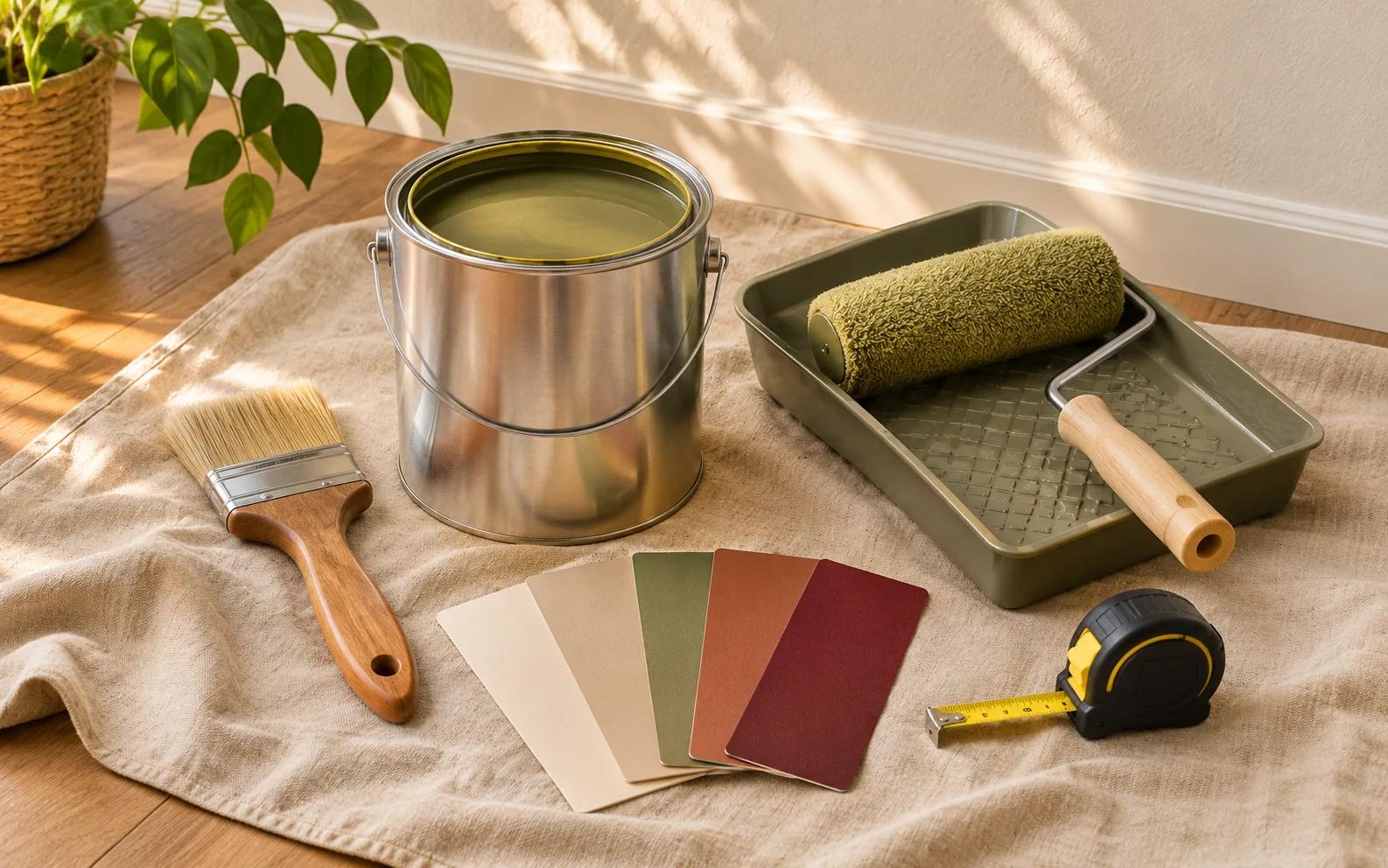
How to use the paint calculator
- Measure the room. Choose feet or metres, then enter length, width and wall height. Start with a room preset if useful. Expand doors and windows to enter their counts and dimensions.
- Choose what you are painting. Select walls, ceiling or trim, set your coats, and add primer if required. Under coverage and finishes, replace the starting rates with your product label's coverage.
- Check your shopping quantities. Results update immediately. Choose the container size sold by your retailer, add optional prices and print your estimate. Add another room for a shared-paint project.
Keep the 10% allowance for a planning buffer, or turn it off to see the underlying estimate. The allowance is a choice, not a guarantee that every surface or application method will be covered.
Paint coverage by finish
Use these as editable starting assumptions for a smooth, prepared surface. Finish alone does not determine coverage. Product formulation, surface porosity and application thickness matter more than the name on the sheen selector.
| Finish | Sq ft / US gallon | Tool default, m² / litre |
|---|---|---|
| Flat / matte | 350 | 8.59 |
| Eggshell | 350 | 8.59 |
| Satin | 350–400 | 9.20 |
| Semi-gloss | 400 | 9.82 |
| Gloss | 400–450 | 10.43 |
For context, BEHR's interior paint guide lists 250–400 square feet per gallon for the products it discusses and notes that rough or porous surfaces may need more paint. This calculator is independent and is not affiliated with a paint brand.
How much paint for common room sizes?
These are wall-only examples: 8-foot ceilings, one 3×7-foot door and two 3×4-foot windows per room, two coats, 350 sq ft per US gallon, and 10% extra. Each row is calculated using the same formula as the tool.
| Room / project | Calculated need | Buy in 1-gal cans |
|---|---|---|
| 10×10 bedroom | 1.73 US gal / 6.54 L | 2 US gal |
| 12×12 bedroom | 2.13 US gal / 8.07 L | 3 US gal |
| 12×18 living room | 2.73 US gal / 10.35 L | 3 US gal |
| 13×13 kitchen | 2.33 US gal / 8.83 L | 3 US gal |
| 2,000 sq ft house (illustration only) | 27.34 US gal / 103.50 L | 28 US gal |
The whole-house illustration assumes ten 10×20-foot rooms and the same wall paint and colour throughout. It is not a floor-area conversion rule. Kitchens may have additional unpainted areas behind cabinets; deduct these separately or measure the exposed wall area. Different colours require separate rounding.
How much paint do I need for a ceiling?
A flat rectangular ceiling's area is length × width. A 12×12-foot ceiling is 144 square feet. At 350 sq ft per gallon, two coats and 10% extra need about 0.91 US gallons (3.43 litres), so one gallon is the rounded purchase estimate. Switch on Ceiling in the tool to calculate it alongside your walls.
Measure sloped or vaulted ceilings along the actual surface instead of using the floor footprint. Textured ceilings may need a lower coverage rate. Confirm that your chosen product is intended for the ceiling material and room conditions.
Exterior paint: what changes?
For a rectangular building, the wall formula still works: exterior perimeter × wall height, minus openings. Enter the exterior dimensions and turn off Ceiling. The tool does not automatically add gables, dormers or other irregular shapes. Measure these separately; a triangular gable's area is base × height ÷ 2.
For a rough surface, you can explore a 20–30% lower coverage rate as a planning scenario: a 350 sq ft/gal starting rate becomes 245–280 sq ft/gal. This is an adjustable assumption, not a universal exterior-paint rule. Use the manufacturer's specification for your substrate and account for application losses.
How much primer do I need?
Primer is a separate product with its own coverage and coat count. The default is 250 sq ft per US gallon (6.14 m² per litre), within the 200–300 sq ft range in Sherwin-Williams' paint calculator guidance.
One primer coat over the example 12×12 room's 339 sq ft of walls, plus 10% extra, needs 1.49 US gallons, rounded up to two one-gallon cans. Select Primer to include all enabled surfaces. New drywall, staining and major colour changes may require specific preparation; follow the selected product's instructions.
What does the paint cost?
Material cost = rounded purchase quantity × price per unit. Enter separate prices for wall paint, ceiling paint, trim paint and primer. The tool adds the priced products and flags a partial estimate when another selected product has no price.
For example, buying three gallons of wall paint at $40 per gallon and two gallons of primer at $25 per gallon gives a $170 material estimate. These are illustrative prices, not current retail quotes. Labour, surface repairs, brushes, rollers, masking, tax and delivery are excluded.
One-quart cans can cost more per gallon than large cans. Enter an equivalent per-gallon or per-litre price for your chosen container size. Currency selection changes the display label; it does not convert currencies.
The formula behind your paint estimate
Wall area = 2 × (length + width) × height − total door and window area
Ceiling area = length × width
Trim area = trim length × average painted face width
Paint needed = area × coats ÷ coverage × allowance factor
Containers to buy = round up (paint needed ÷ container size)
The allowance factor is 1.10 with the buffer on, or 1.00 with it off. Primer uses its own coat count and coverage. All internal quantities use feet and US gallons; 1 foot = 0.3048 metres and 1 US gallon = 3.785411784 litres.
Worked example: a 12×12 bedroom
Four 8-foot walls total 384 sq ft. Subtract one 21 sq ft door and two 12 sq ft windows to get 339 sq ft. Then 339 × 2 ÷ 350 × 1.10 = 2.13 US gallons. With one-gallon containers, round up to 3 gallons. With quart containers, round up to 9 quarts (2.25 gallons).
What is included in trim?
Automatic trim length is the room perimeter minus door widths, representing baseboards only. The default face width is 3 inches (7.62 cm). Enter a measured total length to include door casings, window surrounds or crown moulding, and set an appropriate average face width. Door slabs and cabinet faces are not included.
Rectangular rooms and flat surfaces are assumed. Dimensions remain on this page and are not submitted to a server. Reloading resets the calculator; print or save your estimate before leaving.
Paint calculator FAQs
How many gallons of paint do I need for a 12×12 room?
For a 12×12-foot room with 8-foot walls, one 3×7-foot door and two 3×4-foot windows, the paintable wall area is 339 square feet. Two coats at 350 square feet per US gallon, plus 10% extra, need about 2.13 gallons (8.07 litres). Buy 3 one-gallon cans, or 9 one-quart cans if your product is sold in quarts. Ceiling, trim and primer are additional.
How much does one gallon of paint cover?
A useful starting estimate is 350 square feet per US gallon for one coat, equivalent to about 8.59 square metres per litre. Actual coverage varies by product and surface. At that rate, two coats cover 175 square feet per gallon before adding a waste allowance. Enter the coverage printed on your paint label for a more useful estimate.
How many coats of paint do I need?
The calculator starts with two topcoats. Some products and prepared surfaces may need only one, while large colour changes or patchy coverage can require three. Follow the product instructions, including the recommended primer, drying time and application thickness. Primer is calculated separately from topcoats.
Can I use the same paint on the ceiling and walls?
Only if the product is suitable for both surfaces. Ceiling paint is often chosen for a flat appearance, while wall finishes depend on the room and cleaning needs. This calculator keeps ceiling and wall quantities separate so you can buy different products. If they truly use the same paint and colour, combine the unrounded needs before choosing cans.
How much primer do I need?
At the default 250 square feet per gallon, one primer coat on the example 12×12 room’s 339 square feet of walls, plus 10% extra, needs about 1.49 US gallons (5.65 litres). Buy 2 one-gallon cans. The primer option covers every selected surface; change its coverage and coat count to match your primer and preparation needs.
Does the calculator work in metres and litres?
Yes. Switch to Metric to enter room dimensions in metres, coverage in square metres per litre and prices per litre. Existing measurements and unit prices convert without changing the physical room. Results show both litres and US gallons. One US gallon is 3.785411784 litres; UK imperial gallons are not used.
Can I use this as an exterior paint calculator?
For a simple rectangular building with vertical walls, enter the exterior length, width and wall height, deduct openings, and leave ceiling and trim off unless needed. Use the exterior product’s coverage rate. Gables, irregular facades, deep textures and inaccessible sections require separate measurements; floor area alone does not describe exterior wall area.
How much paint do I need for a 2,000-square-foot house?
Floor area alone cannot determine interior paint quantity: room layout, ceiling height, doors and windows all matter. Add each room for a measured estimate. As an illustration only, ten 10×20-foot rooms with 8-foot walls, one standard door and two standard windows each need about 27.34 gallons for two wall coats at 350 square feet per gallon with 10% extra. That rounds to 28 one-gallon cans only if all walls share the same paint and colour.
Plan the room around your new colour
Updating a floor or backsplash too? Our tile calculator estimates tiles, boxes, grout, mortar and costs for the same project. Building shelves or wood furniture? Use the board foot calculator to plan lumber and stock boards.
Published by Live Decor Well · Method and examples updated . Found a calculation issue? Contact us.
Planning a wallpaper accent wall?
Use our wallpaper calculator to count strips, account for pattern repeats and estimate rolls or panels for the same room.