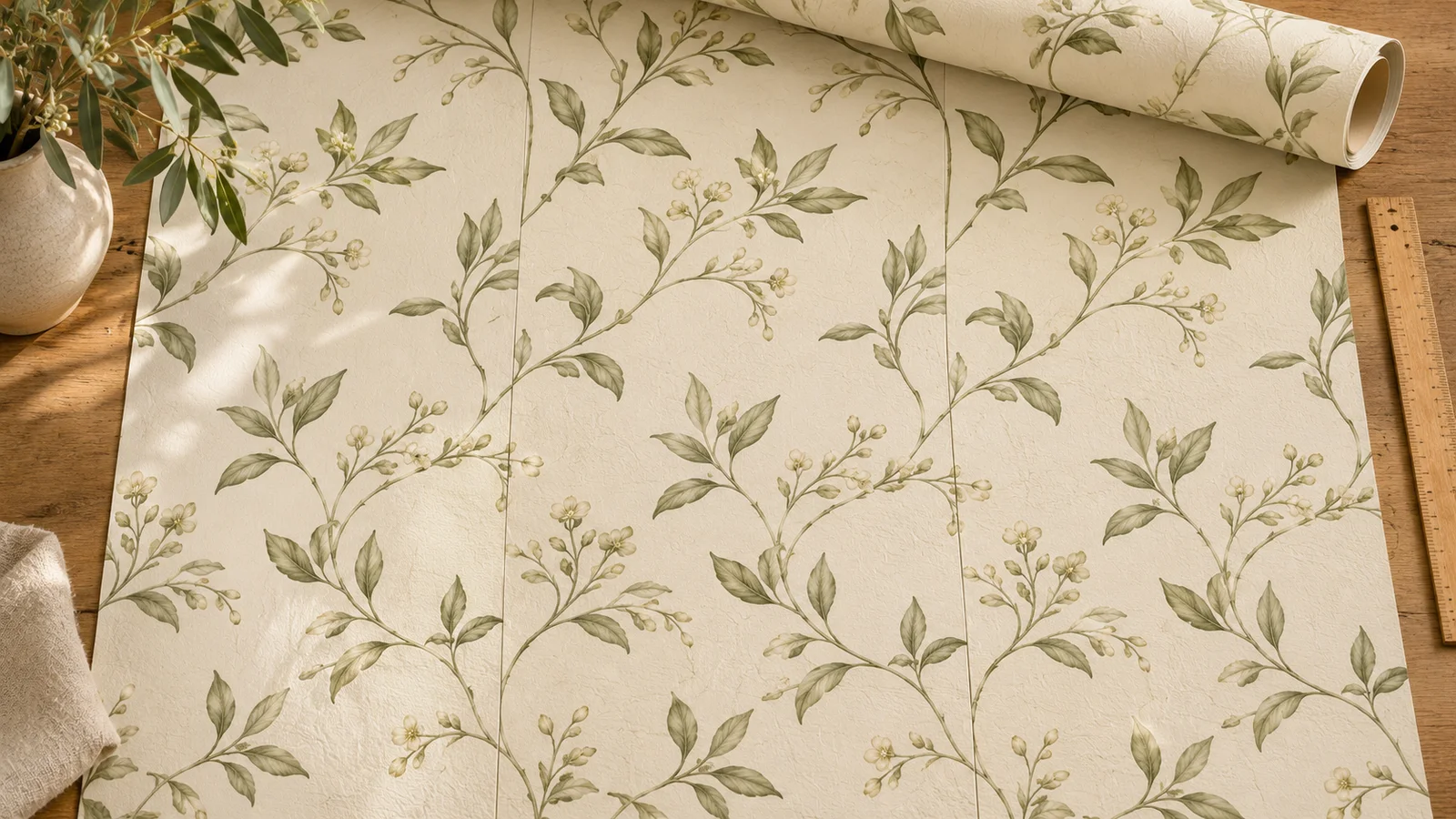
A pattern repeat is the distance down the roll before the same design appears again. It affects the cutting allowance, but does not always add a whole roll to the order. Compare usable drops per roll with identical height and trim assumptions before deciding how much extra the pattern costs.
Reviewed by Live Decor Well · Last reviewed . Calculation and source review: November 21, 2026. Half-drop figures are conservative allowances, not optimized cutting plans. Images are generated editorial illustrations, not installation evidence.
Inside this story
Manufacturer and retailer links help verify specifications and prices. This guide is based on research, not hands-on product testing.
What is a pattern repeat in wallpaper?
The vertical repeat measures from a point in the design to the same point when it appears again down the roll. A 21-inch repeat means that motif recurs every 21 inches. The match type then tells you how adjacent strips should align across the wall, which is a separate piece of information.
Copy both values from the roll label or product page into our wallpaper pattern repeat calculator. Do not guess from the product photograph: the visible sample may not show a complete repeat, and two similar designs can use quite different print scales.
Some designs have no required alignment even though they look patterned. Others need an offset different from a half-drop, reverse hanging or a specific panel order. Where the label does not fit the calculator’s straight, random or conservative half-drop modes, use the manufacturer’s layout rather than forcing it into a close approximation.
Straight match vs half-drop vs random match
Straight match aligns corresponding design elements at the same height on neighbouring drops. Half-drop shifts alternate strips by half a repeat, creating a diagonal arrangement. Random or free match needs no seam alignment. These instructions describe how strips meet, not just whether the wallpaper has flowers, stripes or a visible texture.
The Wallcovering Installers Association’s pattern-match guidance distinguishes random, straight-across and drop matches. Half-drop is one kind of drop match; other offsets exist. Check the exact product instructions when laying out a large design or a prominent focal wall.
Our half-drop option adds half a repeat after rounding height plus trim to whole repeats. This is a conservative per-drop allowance, not a claim that every installer must cut every strip that way. An alternating A/B cutting plan, especially across multiple rolls, can change the usable yield.
| Match | Design alignment | Allowance |
|---|---|---|
| Random / free | No seam alignment required | Wall height + trim |
| Straight | Adjacent motifs at the same level | Height + trim, rounded up to full repeats |
| Half-drop | Alternate strips offset by half a repeat | Rounded straight allowance + half a repeat; conservative |
How to calculate wallpaper with pattern repeat
Add total trim to the wall height, divide by the repeat and round up, then multiply by the repeat to find the straight-match allowance. Divide roll length by that value and round down. Finally, count each wall’s drops separately and divide the total by the roll yield, rounding the purchase up.
For one continuous 40 ft wall at 8 ft height, using 4 in trim and a 21 in repeat: 96 + 4 = 100 in, then ceiling(100 ÷ 21) × 21 = 105 in per drop. A 33 ft roll is 396 in long, so floor(396 ÷ 105) = 3 full drops.
At 20.5 in roll width, ceiling(480 ÷ 20.5) = 24 drops across that one wall. Divide 24 by 3 for 8 rolls before extra buffer. A 10% buffer raises the requirement to 27 whole drops, or 9 rolls. The spare is additional: 10 rolls if you choose to include one.
For a four-wall room, repeat the width calculation four times and add the rounded values. Do not simply substitute the perimeter for a continuous wall: partial-width pieces at corners may not carry over. The tool assumes each wall begins a new strip layout.
Plain paper still needs trim
Removing pattern matching does not remove the extra material needed at the top and bottom of a strip. At an 8 ft wall height plus 4 in trim, plain paper needs 100 in per drop. A 396 in roll cannot supply four of those drops because they require 400 in.
The York installation guide recommends roughly 4 extra inches, split between top and bottom, while also requiring attention to the match and product instructions. This article keeps that trim assumption the same when comparing patterned and plain paper.
The 40 ft example therefore needs 8 rolls minimum for both plain and 21 in straight-match paper. A claim of 6 plain rolls versus 8 patterned rolls uses zero trim for the plain case. That comparison changes two inputs at once and should not be described as the cost of pattern repeat alone.
How much waste does each repeat add?
Pattern waste depends on how the required height fits into a whole number of repeats. The unused length left on each roll then creates another threshold. A slightly larger repeat may add no rolls, while a small change in wall height may reduce the yield by a full drop and increase the order substantially.
For the same 8 ft wall and 4 in trim, an 18 in repeat gives 108 in per drop; a 21 in repeat gives 105 in. The larger repeat wastes less in this particular comparison because five repeats land closer to the needed 100 in than six 18-inch repeats do.
A 36 in straight repeat also gives 108 in here, so “larger repeat” is not a reliable fixed percentage rule. Half-drop with a 36 in repeat uses a conservative 126 in allowance, still three per 396 in roll. A 48 in straight repeat uses 144 in and yields only two; the specific thresholds matter.
| Match / repeat | Allowance per drop | Drops per roll | Rolls for 24 drops |
|---|---|---|---|
| Random / plain | 100 in | 3 | 8 |
| Straight / 18 in | 108 in | 3 | 8 |
| Straight / 21 in | 105 in | 3 | 8 |
| Half-drop / 21 in | 115.5 in | 3 | 8 |
| Straight / 48 in | 144 in | 2 | 12 |
A metric wallpaper repeat example
Metric calculations use the same strip logic with consistent units. For a 4.2 × 3.6 m room, 2.4 m height, 10 cm trim, 53 cm straight repeat and 53 cm × 10.05 m rolls, the required cutting allowance is 265 cm. Each roll yields three full drops under those assumptions.
The four wall counts are ceiling(4.2 ÷ 0.53), ceiling(3.6 ÷ 0.53), then the same two counts again: 8 + 7 + 8 + 7 = 30 drops. With no extra buffer that is 10 rolls, or 11 including a spare. With a 10% extra buffer it becomes 33 drops and 11 rolls, before the spare.
Enter wall widths and height in metres and repeat in centimetres in metric mode. A nominal 21-inch repeat is 53.34 cm, not exactly 53 cm; use the label value rather than swapping approximate measurements at a rounding threshold.
Where do I find the repeat?
Look on the roll label, sample book or product page for “pattern repeat,” “repeat” or “rapport,” together with the match symbol or written description. Record the number and unit. The design photograph alone does not tell you the cutting repeat, physical roll length or whether the product is a numbered panel set.
Keep a photo of the label with your order details. Confirm batch numbers before cutting, and ask the retailer when the listing omits the match or gives conflicting dimensions. Product-specific instructions take precedence over a general calculator preset.
Ceilings over 9 feet and large repeats
For a tall wall, measure its highest point and calculate the full cutting allowance before assuming a roll will produce three drops. There is no universal rule that every ceiling above 9 ft needs one extra repeat. The correct allowance depends on trim, motif placement, the match and manufacturer instructions.
At 9 ft height plus 4 in trim and a 21 in straight repeat, 112 in rounds up to 126 in. Three of those drops use 378 in of a 396 in roll. At a slightly taller height the allowance can jump to 147 in, reducing the roll to two drops. Always round yield down.
For the complete room-shopping process, read how many rolls of wallpaper do I need. Use the wallpaper calculator with repeat to try your actual product dimensions. If you are coordinating a tiled surface, our tile calculator handles its separate coverage and cutting allowance.
Frequently Asked Questions
You Might Also Love
How Many Rolls of Wallpaper Do I Need?
A 12 × 10 ft room with 8 ft walls needs 28 drops when using 20.5-inch-wide wallpaper. With 4 inches of trim and an 18-inch straight repeat, a 33 ft double roll yields 3 drops: 10 rolls minimum, 11 with a 10% extra buffer, or 12 including one spare.
30 Modern Living Room Ideas
Discover 30 stunning modern living room ideas with curved sofas, statement lighting and contemporary decor. Transform your space with these 2026 interior design trends.
25 Dark Luxury Bedroom Ideas
Transform your master bedroom with these 25 dark luxury bedroom ideas. Forest green velvet headboards moody color palettes and five star hotel inspired designs for American homes 2026.