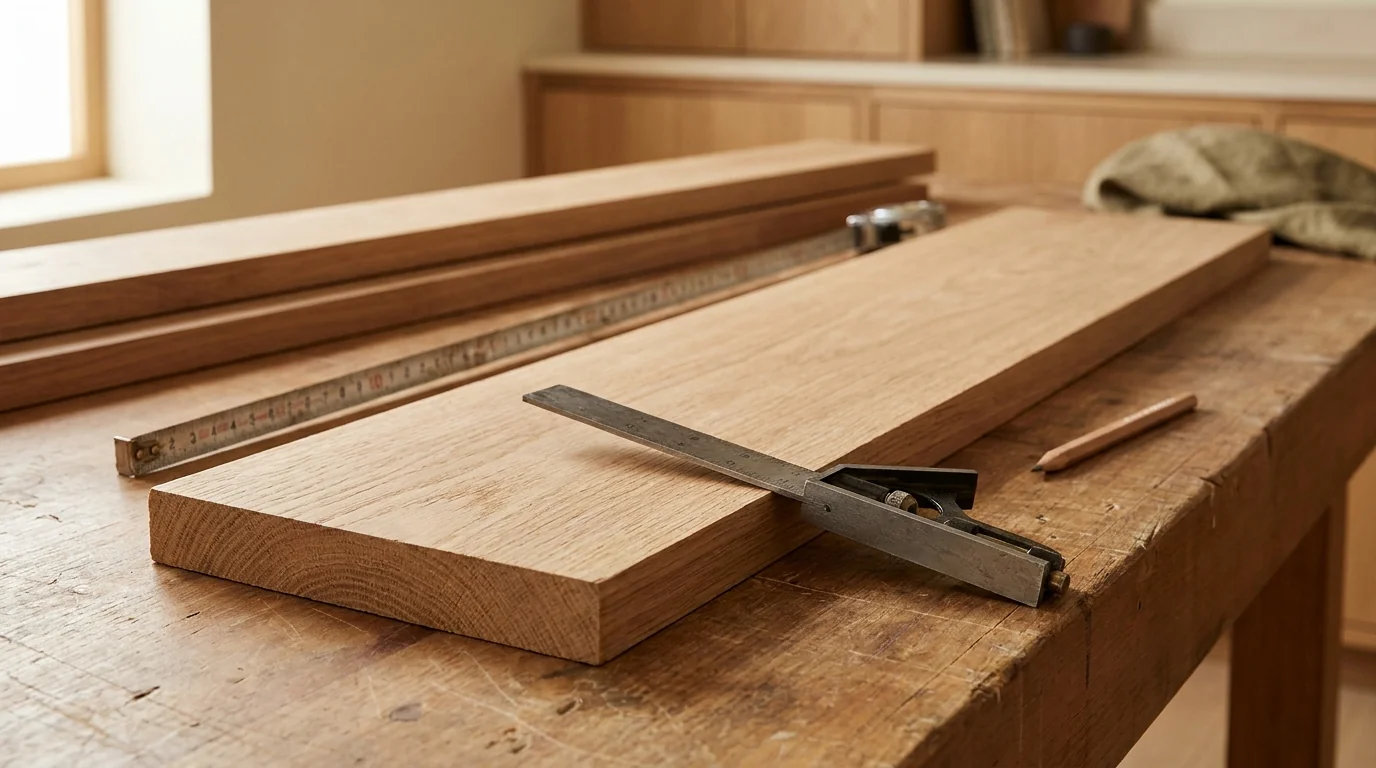
To calculate board feet, multiply thickness in inches by width in inches by length in feet, then divide by 12. A 1×6 board at 8 feet is 4 board feet. Before entering dimensions, decide whether you need nominal purchase tally or the physical volume of a measured board.
Reviewed by Live Decor Well · Last reviewed . Source and calculation review; no hands-on product testing or professional certification is claimed.
Inside this story
Manufacturer and retailer links help verify specifications and prices. This guide is based on research, not hands-on product testing.
How to calculate board feet before a lumber-yard visit
Start with the project parts, then identify the stock you can actually buy. A board-foot total tells you how much volume is needed; it does not prove that the parts will fit into the available boards. Write down thickness, width, length and quantity before comparing prices or choosing a waste allowance.
The board foot calculator handles individual boards, a project cut list and live-edge slabs. For a shelf, enter the stock dimensions and quantity. For furniture with several part lengths, switch to Project and enter a row for each size. The shopping list accounts for whole stock lengths rather than assuming all offcuts can be reused.
Before visiting the yard, ask whether the quotation is per board foot, per piece or per linear foot. Also ask whether it describes rough, surfaced, green or kiln-dried material. Those details change what you receive even when two quotes show the same number of board feet.
What is a board foot?
A board foot is a volume equal to 144 cubic inches: imagine a piece 1 inch thick, 12 inches wide and 12 inches long. It is not a one-foot cube. Twelve board feet make one cubic foot, and different board shapes can contain exactly the same volume.
This is useful when hardwood comes in different widths and lengths. An 8-foot board 6 inches wide and 1 inch thick holds the same volume as a 4-foot board 12 inches wide and 1 inch thick: 4 BF. They are not interchangeable for every project, even though their board-foot quantities match.
Use the abbreviation BF or bd ft on a shopping list. Avoid writing only “feet,” which could mean length rather than volume. That small clarification makes it easier to compare your calculation with a written supplier quote.
The board feet formula, with units
Board feet = thickness in inches × width in inches × length in feet ÷ 12. If all three dimensions are in inches, divide by 144 instead. Multiply by quantity after calculating one board, and retain the unrounded result until the final total so small rounding differences do not accumulate.
For ten identical 1×6 boards at 8 feet: 1 × 6 × 8 ÷ 12 = 4 BF per board, and 4 × 10 = 40 BF. With a 15% buying allowance, 40 × 1.15 = 46 BF. The extra 6 BF is an allowance, not a change to the original board dimensions.
For metric measurements, convert thickness and width from millimetres to inches by dividing by 25.4, and length from metres to feet by dividing by 0.3048. The calculator does this internally. It uses the exact conversion of 0.002359737216 m³ per BF, rather than rounding the conversion at each step.
| Inputs | Formula |
|---|---|
| Thickness/width in inches, length in feet | T × W × L ÷ 12 |
| All dimensions in inches | T × W × L ÷ 144 |
| Volume in cubic feet | Volume × 12 |
| Volume in cubic metres | Volume ÷ 0.002359737216 |
Worked examples and a board feet chart
The examples below use the stated thickness and width, so they can serve as nominal tally examples for standard softwood. They are not claims about the physical size of dressed boards. Match the units carefully, then multiply the single-board result by quantity before adding any purchase allowance.
An 8-foot nominal 2×4 is 2 × 4 × 8 ÷ 12 = 5.333… BF. Ten are 53.333… BF, not 53.3 BF from repeatedly adding a rounded one-board display. Keep the full calculation when comparing a larger order or estimating cost.
A 2×12 at 16 feet is 32 BF. It has six times the nominal board-foot volume of the 8-foot 2×4, even though it is only twice as long. Thickness and width are essential; length alone cannot tell you how much wood an order contains.
| Nominal size | 8 ft | 10 ft | 12 ft | 16 ft |
|---|---|---|---|---|
| 1×4 | 2.67 | 3.33 | 4 | 5.33 |
| 1×6 | 4 | 5 | 6 | 8 |
| 1×12 | 8 | 10 | 12 | 16 |
| 2×4 | 5.33 | 6.67 | 8 | 10.67 |
| 2×6 | 8 | 10 | 12 | 16 |
| 2×12 | 16 | 20 | 24 | 32 |
Nominal vs actual size: choose the correct basis
Use nominal dimensions when calculating a standard softwood board-measure tally, and actual dimensions when calculating physical volume. For random-width hardwood, confirm the supplier’s thickness and tally conventions. A calculator cannot infer the billing basis from a measurement alone, so “always nominal” is too broad a rule for every kind of lumber.
The American Softwood Lumber Standard PS 20-25 distinguishes nominal sizes, dressed sizes and measurement conventions. A dry surfaced nominal 2×4 typically measures 1½ × 3½ inches. At 8 feet, those measured dimensions represent 3.5 BF of physical wood, while the nominal tally is 5.33 BF.
Ask the supplier to show how one sample board is tallied. Confirm the thickness basis, measured width, counted length and any rounding. Do not assume every yard rounds every board upward; tally conventions vary and can round differently from a simple geometric estimate.
| Nominal size | Dry dressed size (in) |
|---|---|
| 1×4 | ¾ × 3½ |
| 1×6 | ¾ × 5½ |
| 1×8 | ¾ × 7¼ |
| 1×12 | ¾ × 11¼ |
| 2×4 | 1½ × 3½ |
| 2×6 | 1½ × 5½ |
| 2×8 | 1½ × 7¼ |
| 2×10 | 1½ × 9¼ |
| 2×12 | 1½ × 11¼ |
| 4×4 | 3½ × 3½ |
Hardwood quarters: what 4/4 and 8/4 mean
Quarters describe rough hardwood thickness in quarter-inch increments. Four-quarter, written 4/4, means a nominal 1-inch rough thickness; 8/4 means 2 inches. These labels do not guarantee the finished thickness after planing. Buy a rough thickness that leaves enough material to flatten the board and reach the finished size you need.
The NHLA grading rules are the relevant hardwood reference, not a substitute for checking an individual seller’s product description. Ask whether the price uses rough thickness, how surfaced widths are handled and whether the tally is before or after drying.
The other common quarter labels are 5/4 = 1¼ inches, 6/4 = 1½ inches, 12/4 = 3 inches and 16/4 = 4 inches. A surfaced 4/4 board might be sold at about 13/16 inch, but inspect the actual listing. A finished top that must be a full 2 inches thick may require stock thicker than 8/4.
How many board feet do I need, including waste?
Calculate the net volume first, then choose a buying allowance that reflects your cuts and material. Ten percent for framing, fifteen percent for many short parts and fifteen to thirty percent for rough hardwood are practical example settings. They are not universal standards, and none guarantees that every required part will fit.
A 72 × 36 × 2 inch tabletop contains 36 BF. Adding 15% gives 41.4 BF; adding 30% gives 46.8 BF. These are volume targets. Grain matching, cracks, narrow usable widths and stock lengths can require buying more. If the thickness is a finished dimension, include milling needs before selecting rough boards.
For crosscuts, two 4-foot finished parts do not fit into a precisely 8-foot board once a saw cut removes material. The project calculator accounts for this through kerf and combined end trim. It groups equal cross-sections, fits longer parts first and keeps the allowance separate from the packing requirement.
A slab needs a different check. Average the usable widths for an approximate volume, then measure its narrowest usable section to confirm that your design will fit. Averaging does not restore material lost to bark, a deep edge curve or a void.
Turn the volume into a usable budget
Multiply the volume you expect to purchase by a supplier quote expressed per board foot on the same tally basis. Keep tax, delivery and milling separate unless the quote includes them. Species price examples are useful for exploring a budget, but they should not be presented as verified current local prices.
At an illustrative US$6/BF, 40 BF of red oak costs US$240 before waste. A 15% allowance raises the target to 46 BF and the estimate to US$276. If the stock plan requires 48 BF in whole boards, the material cost becomes US$288. Compare the amount you actually must purchase, not only the net project volume.
For a clearer explanation of quotes by length, read board foot vs linear foot. Planning a room renovation as well? Our tile calculator estimates tiles and boxes, while kitchen shelving ideas can help you choose a project before measuring.
Frequently Asked Questions
You Might Also Love
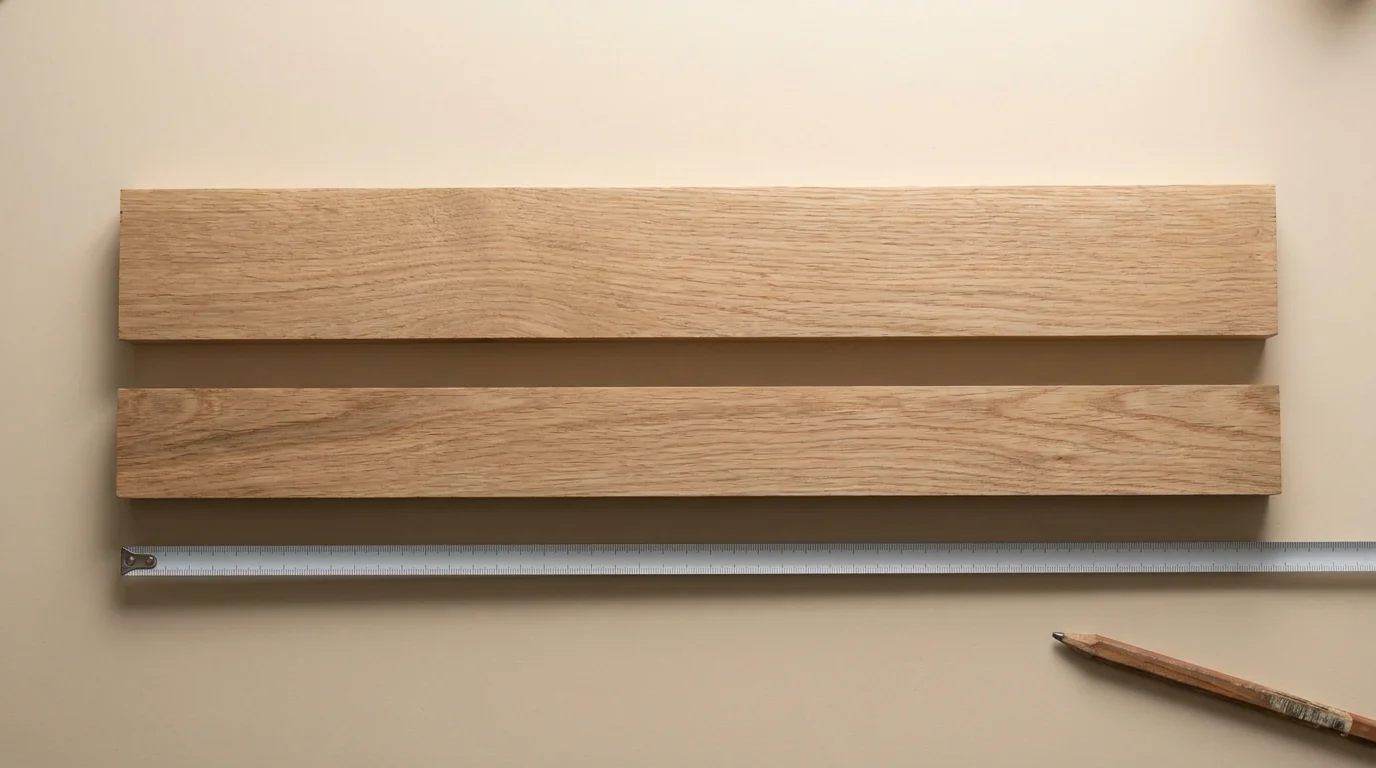
Board Foot vs Linear Foot: What’s the Difference?
A board foot measures wood volume; a linear foot measures length. One linear foot of 1×6 stock is 0.5 board feet, while one linear foot of 2×12 stock is 2 board feet. Always ask which unit a “per foot” quote means before comparing prices or placing an order.
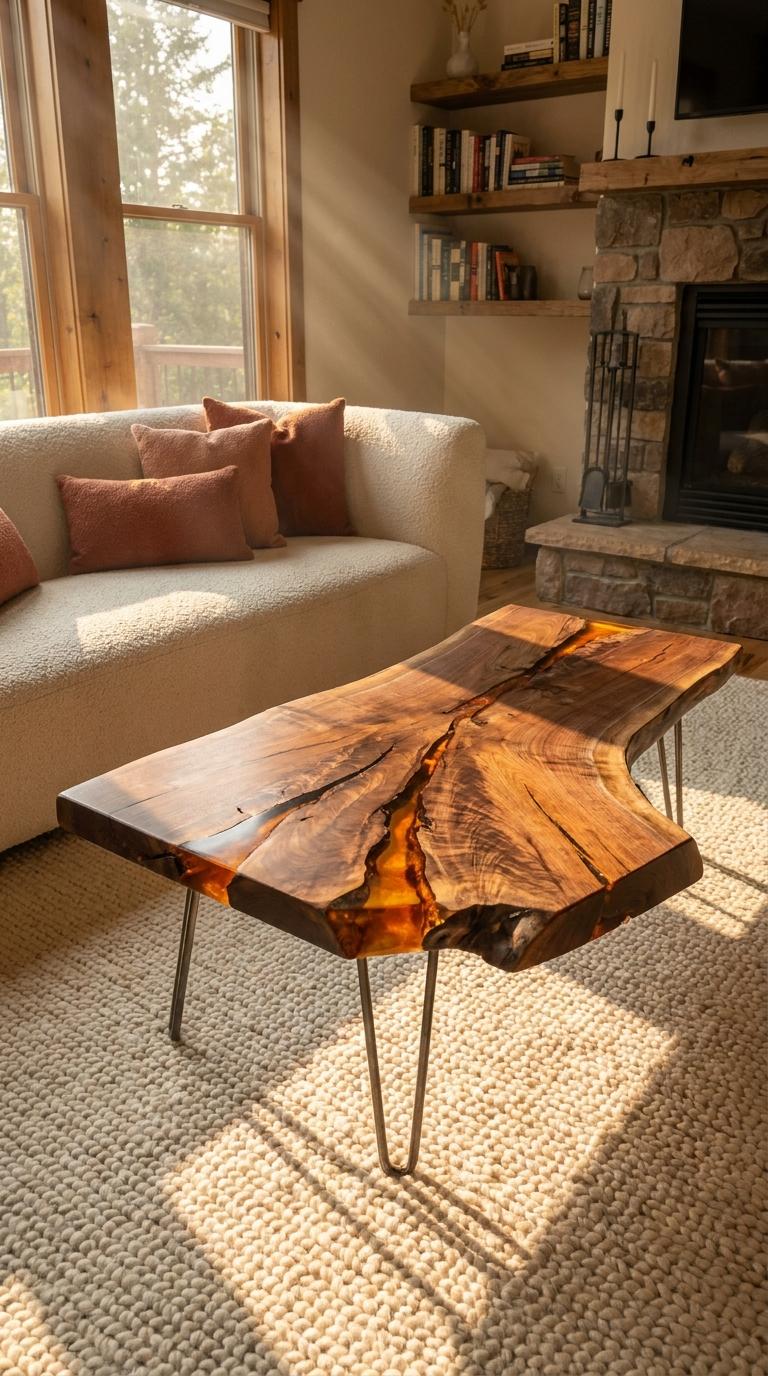
25 Live Edge Coffee Table Ideas
Discover 25 breathtaking live edge coffee table ideas including black walnut epoxy resin designs, natural slab tables and handmade wood furniture for American homes in 2026.
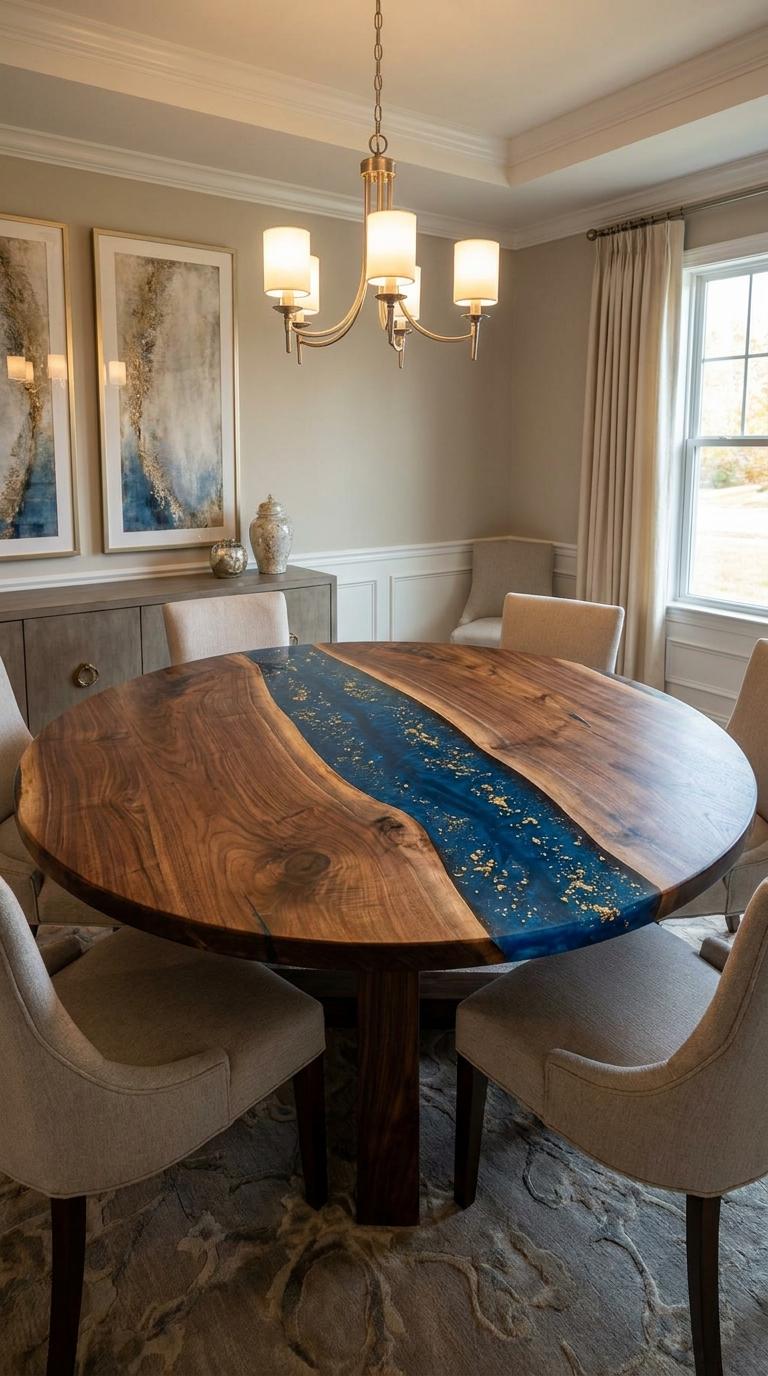
25 Stunning Wood Epoxy Resin Table Ideas for
Discover 25 breathtaking wood epoxy resin table ideas including dried flower designs, river tables and DIY epoxy furniture for your dream home in 2026.