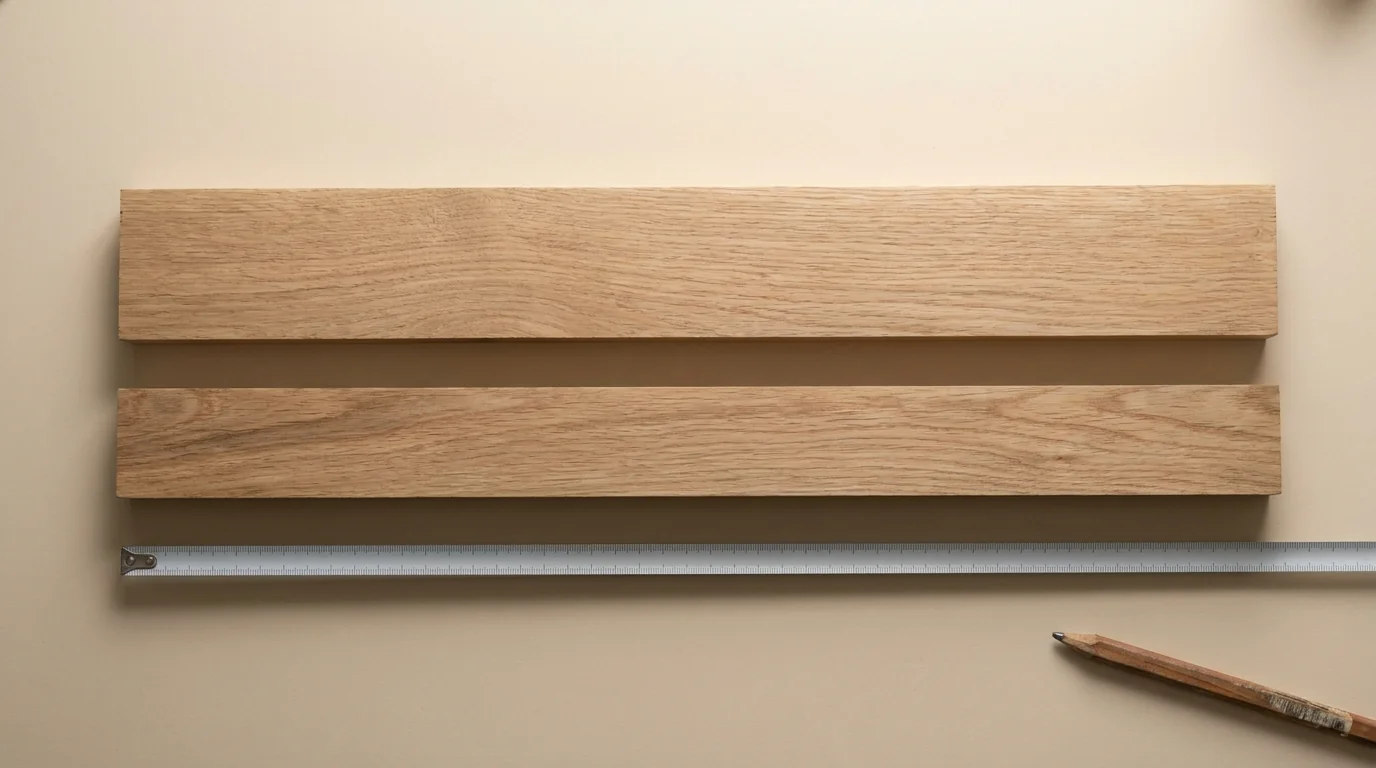
A board foot measures wood volume; a linear foot measures length. One linear foot of 1×6 stock is 0.5 board feet, while one linear foot of 2×12 stock is 2 board feet. Always ask which unit a “per foot” quote means before comparing prices or placing an order.
Reviewed by Live Decor Well · Last reviewed . Source and calculation review; no hands-on product testing or professional certification is claimed.
Inside this story
Manufacturer and retailer links help verify specifications and prices. This guide is based on research, not hands-on product testing.
Board foot vs linear foot at a glance
The difference is the dimension being measured: linear feet count length, while board feet include thickness, width and length. Equal lengths can contain very different volumes of wood. Choose the unit shown on the supplier quote, and use a conversion only after confirming the thickness and width on that same measurement basis.
Imagine two 8-foot boards, one 1×6 and the other 2×12. Each is 8 linear feet long. The first contains 4 BF and the second contains 16 BF using those stated dimensions. A price per linear foot alone does not describe their relative cost per unit of wood.
These calculations use stated dimensions rather than silently switching between nominal and dressed sizes. Standard softwood size names and actual finished measurements differ; hardwood billing can use rough thickness and specific tally conventions. Confirm the basis before treating a calculated comparison as an invoice.
| Board | Linear feet | Board feet | BF per linear foot |
|---|---|---|---|
| 1×6 × 8 ft | 8 | 4 | 0.5 |
| 1×12 × 8 ft | 8 | 8 | 1 |
| 2×4 × 8 ft | 8 | 5.33 | 0.667 |
| 2×12 × 8 ft | 8 | 16 | 2 |
What is a linear foot?
A linear foot is twelve inches of length measured along the board, regardless of thickness or width. An eight-foot 2×4 and an eight-foot 4×4 are both eight linear feet. This makes linear footage useful for runs of one fixed profile, such as trim, provided you keep the profile specification alongside the total.
For baseboard, you might measure 48 feet around a room and deduct openings before allowing for joints and cuts. That gives a length requirement, not a lumber-volume estimate. Whether the store sells that trim by the foot or in fixed pieces, the width and profile still need to match your design.
Do not add lengths of unrelated profiles into one purchase quantity without keeping separate lines. Twenty feet of narrow trim cannot replace twenty feet of wide shelving. A useful shopping list records the profile or cross-section, the needed lengths, and the unit used for the price.
What is a board foot?
A board foot is a lumber-volume unit equal to 144 cubic inches. Picture a piece one inch thick, twelve inches wide and twelve inches long. Other proportions can hold the same volume. Board-foot pricing is useful for comparing boards with different widths and lengths, although grade and usable yield still affect value.
The formula is thickness in inches × width in inches × length in feet ÷ 12. A 1×12 at 8 feet is 8 BF; a 1×6 at 8 feet is 4 BF. Doubling thickness while holding the other dimensions constant doubles the volume again.
For dimension selection and purchase allowances, see how to calculate board feet. It explains why a nominal softwood tally, a physical measurement and a supplier’s hardwood tally can produce different numbers without changing the underlying geometric formula.
How to convert board feet to linear feet
Convert board feet to linear feet by multiplying board feet by twelve, then dividing by thickness times width in inches. To convert in the opposite direction, multiply linear feet by thickness times width and divide by twelve. Both conversions require a known cross-section; there is no single universal BF-to-LF multiplier.
For 1×6 stock, 40 BF × 12 ÷ (1 × 6) = 80 LF. For 2×12 stock, the same 40 BF × 12 ÷ (2 × 12) = 20 LF. The thicker, wider board reaches the same volume in one quarter of the length.
Our board foot calculator and linear foot converter handles both directions. Select Converter, choose the direction, enter the amount, and supply thickness and width. Metric mode changes the dimension inputs; it does not change a selected linear-foot result into metres.
When an order mixes sizes, convert each line separately and then total board feet. Averaging widths or thicknesses without weighting them by length can distort the answer. Keeping separate lines also preserves the dimensions needed when the supplier assembles the order.
| Input | Calculation | Result |
|---|---|---|
| 100 LF of 2×6 | 2 × 6 × 100 ÷ 12 | 100 BF |
| 100 LF of 1×6 | 1 × 6 × 100 ÷ 12 | 50 BF |
| 40 BF of 1×6 | 40 × 12 ÷ (1 × 6) | 80 LF |
| 40 BF of 2×12 | 40 × 12 ÷ (2 × 12) | 20 LF |
When should you use each pricing unit?
Use linear feet to plan length when the cross-section is fixed, and board feet to compare lumber priced by volume. Either approach still needs dimensions and grade. Dimensional softwood is often sold per piece, while trim may be sold by length and rough hardwood by board foot; check the actual quotation.
For a hypothetical US$6/BF quote, 1×6 stock costs US$3 per linear foot because each LF contains 0.5 BF. At the same BF price, 2×12 stock costs US$12 per linear foot because each LF contains 2 BF. These are arithmetic examples, not current lumber prices.
Convert a per-linear-foot quote to an equivalent BF price by dividing the LF price by the board feet per linear foot. A US$3/LF price on 1×6 gives US$3 ÷ 0.5 = US$6/BF. This comparison is useful only if the dimensions, grade, moisture condition and included services are understood.
A cheaper BF price can still be the more expensive project choice if the boards have too many defects or the wrong lengths. Ask about minimum purchases, delivery, surfacing, straight-line ripping and the handling of unusable ends before making a price-only decision.
The ordering mistake that changes your quantity
An order written only in “feet” can deliver too much or too little material because the missing unit changes the quantity. Include BF or LF explicitly, then record the board dimensions. Before paying, compare the supplier’s tally with your list and make sure both use the same dimension and pricing basis.
Suppose a project needs 40 BF of 1×6 stock, but the order says “40 feet.” If the yard supplies 40 linear feet, the volume is 1 × 6 × 40 ÷ 12 = 20 BF: half the intended amount. You needed 80 LF for that cross-section.
The opposite happens with 2×12 stock. Ordering 40 LF when you intended 40 BF delivers 80 BF by the stated dimensions. You bought twice the intended volume. Ask for the written quantity, size, unit price and total to be confirmed together.
Length fit is a separate issue. Eighty linear feet delivered as ten 8-foot boards is not the same as eighty feet in five 16-foot boards if the design needs long unjoined parts. A BF conversion cannot guarantee that the required cuts fit into the supplied lengths.
What about square feet and cubic feet?
Square feet measure area, cubic feet measure volume, and linear feet measure length. Board feet are also volume, but in a lumber-specific unit. The area covered by one board foot depends on thickness: at one inch thick it is one square foot; at two inches thick it is half a square foot.
For a flat board with no gaps, face area in square feet equals width in inches × length in feet ÷ 12. Multiply that area by thickness in inches to get BF. Flooring coverage may differ because of tongue-and-groove overlap, installation gaps, cutting and the manufacturer’s stated coverage.
Twelve board feet equal one cubic foot. One BF equals exactly 0.002359737216 cubic metres. These are volume conversions; converting a nominal tally does not suddenly make it the physical volume of a dressed board. Keep the original measurement basis attached to the result.
For tile coverage rather than lumber volume, use the tile calculator. For a wood-based room project, explore open shelving kitchen ideas and measure the actual shelf lengths before buying materials.
A short checklist before accepting a lumber quote
A useful quote identifies the species or product, size, grade, moisture condition, quantity unit and price basis. It should also make clear which services and delivery charges are included. Reconcile those details with your cut list, because a correct volume calculation cannot compensate for the wrong stock dimensions or unusable material.
For standard softwood measurement conventions, consult PS 20-25. For hardwood rules, consult NHLA, and ask the seller how the quoted boards are tallied. A calculator supplies an estimate; the agreed measurement and purchasing terms govern the order.
Record the number of stock pieces as well as the total BF or LF. Keep the waste allowance visible, and check that the pieces accommodate the longest parts with saw kerf and end trimming. Then confirm the final material price and any separate charges before collection or delivery.
Frequently Asked Questions
You Might Also Love
How to Calculate Board Feet (With Examples)
To calculate board feet, multiply thickness in inches by width in inches by length in feet, then divide by 12. A 1×6 board at 8 feet is 4 board feet. Before entering dimensions, decide whether you need nominal purchase tally or the physical volume of a measured board.
30 Open Shelving Kitchen Ideas
Transform your kitchen with these 30 open shelving ideas. Sage green, farmhouse, modern and budget-friendly floating shelf inspiration for 2026.
25 Live Edge Coffee Table Ideas
Discover 25 breathtaking live edge coffee table ideas including black walnut epoxy resin designs, natural slab tables and handmade wood furniture for American homes in 2026.