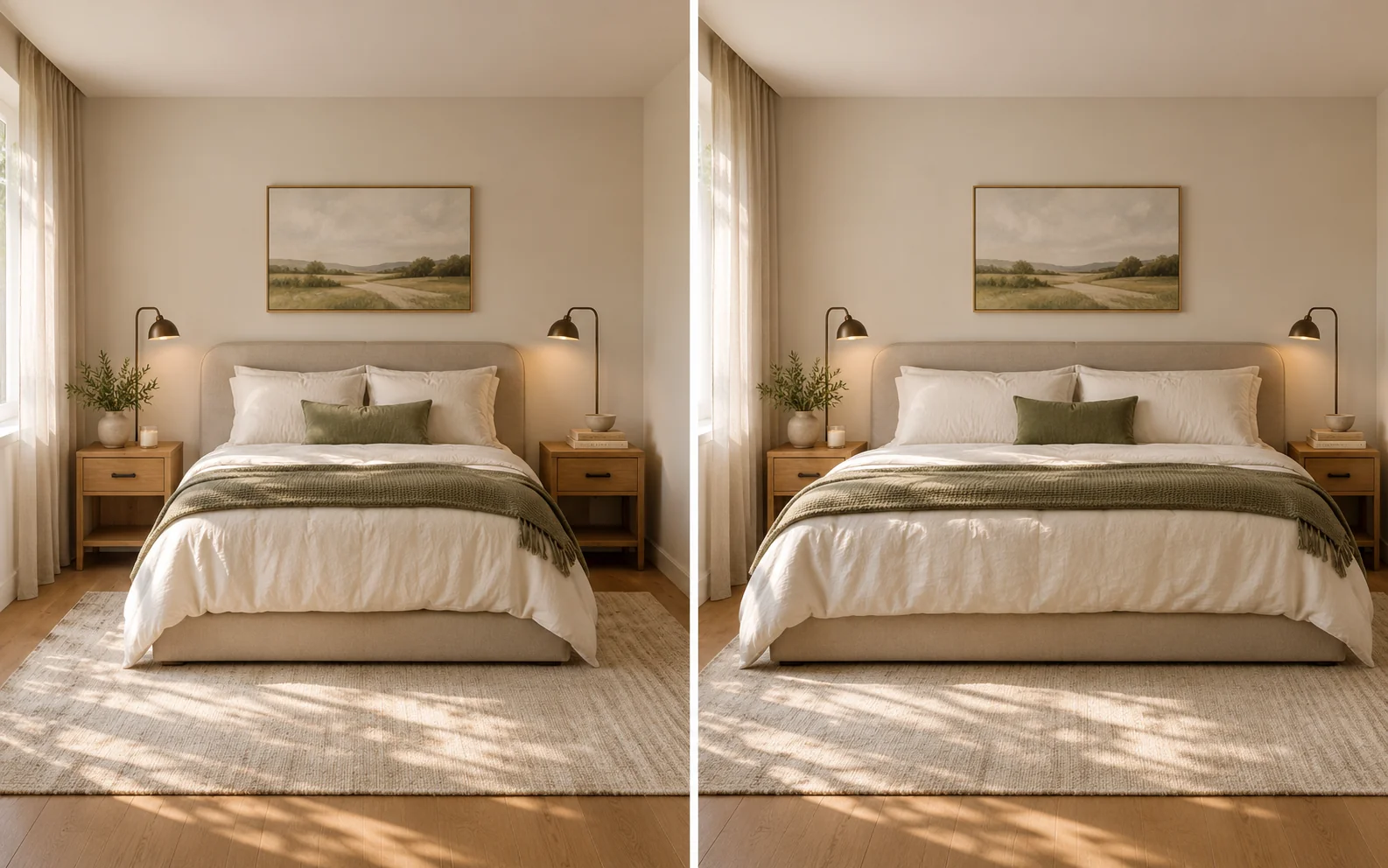
A US queen mattress is nominally 60×80 inches (152.4×203.2 cm); a US king is 76×80 inches (193×203.2 cm). The king adds width, not length. Choose it when both sleepers benefit and the complete frame leaves usable walking space. A queen is often the easier fit in a smaller bedroom.
Reviewed by Live Decor Well · Last reviewed . Source and calculation review; no hands-on product testing or professional certification is claimed.
Inside this story
Manufacturer and retailer links help verify specifications and prices. This guide is based on research, not hands-on product testing.
Queen vs king bed dimensions: how much bigger is a king?
A standard US king is 16 inches (40.6 cm) wider than a queen, while both have a nominal length of 80 inches (203.2 cm). Split evenly between two sleepers, that is 8 inches (20.3 cm) more width each. The difference matters most when the extra width does not squeeze the room around it.
Serta’s bedding dimension reference distinguishes nominal sizes and manufacturing tolerances. Use the familiar size labels for your shortlist, then check the actual mattress and frame drawings before ordering. A product slightly different from the nominal number is not automatically the wrong size, but the base must still be compatible.
A queen has about 33.3 square feet (3.10 m²) of nominal sleeping surface; a king has about 42.2 square feet (3.92 m²). That is roughly 26.7% more area. It does not mean that every king bed costs 26.7% more or needs a room that is 26.7% larger: circulation and furniture layouts do not scale so neatly.
| Size | Width × length | Width per person if shared |
|---|---|---|
| Queen | 60×80 in (152.4×203.2 cm) | 30 in (76.2 cm) |
| King | 76×80 in (193×203.2 cm) | 38 in (96.5 cm) |
| California king | 72×84 in (182.9×213.4 cm) | 36 in (91.4 cm) |
Are queen and king bed sizes the same in the UK and Australia?
No: bed-size names vary by market, and a UK king is not the same as a US king. Compare the actual dimensions when buying a mattress, frame or imported bedding. Australian queen and king labels also differ from the US pairing, so matching a name on two websites is not enough.
John Lewis’s mattress guide lists UK king and super king dimensions. Sealy Australia’s size guide provides its own local dimensions and notes product variation. The table below uses those specified metric measurements; the inch equivalents are rounded conversions rather than a claim that every manufacturer cuts to an identical fraction.
“Queen” is particularly unhelpful as a UK shopping shortcut: some retailers use it for a small double, while imported products may use the US meaning. Canadian buyers should confirm the exact local listing, and New Zealand buyers should use the supplier’s NZ chart rather than automatically copying Australian king dimensions. Check fitted-sheet depth as well as width and length.
| Market / label | Approximate inches | Specified centimetres |
|---|---|---|
| UK king | 59.1×78.7 in | 150×200 cm |
| UK super king | 70.9×78.7 in | 180×200 cm |
| Australia queen (Sealy) | 60×79.9 in | 152.5×203 cm |
| Australia king (Sealy) | 72.2×79.9 in | 183.5×203 cm |
What size bed fits a 10×10-foot room?
In a clear 10×10-foot (3.05×3.05 m) square, a centered US queen mattress leaves 30 inches (76.2 cm) on each side before allowing for the frame. A king leaves only 22 inches (55.9 cm). Both leave 40 inches (101.6 cm) at the foot before furniture, which makes the queen the more flexible starting point.
Those numbers are subtraction, not a recommended minimum bedroom size. A projecting headboard, upholstered rails and a footboard all consume more space. So do skirting boards, radiators and a door that opens into the room. A bed that fits as a rectangle can still make a dresser or wardrobe impossible to use comfortably.
Tape out the full frame, not just the mattress, and open every nearby door and drawer. Walk the route while carrying a laundry basket. If the king leaves only one awkward route, consider a queen with a restrained frame and smaller bedside surfaces. Built-in storage can help, but storage drawers still need somewhere to open.
| Room | Queen side clearance | King side clearance | Foot clearance, either size |
|---|---|---|---|
| 10×10 ft (3.05×3.05 m) | 30 in (76.2 cm) | 22 in (55.9 cm) | 40 in (101.6 cm) |
| 11×11 ft (3.35×3.35 m) | 36 in (91.4 cm) | 28 in (71.1 cm) | 52 in (132.1 cm) |
| 12×12 ft (3.66×3.66 m) | 42 in (106.7 cm) | 34 in (86.4 cm) | 64 in (162.6 cm) |
How much walking space should you leave around a bed?
Choose walking space around the people using the bedroom, not a universal furniture rule. For early planning, test a clear route around 30 inches (76 cm) wide, then increase it where doors, mobility needs or shared use require more. These are layout starting points, not accessibility standards or building-code clearances.
Consider whether both sides really need identical furniture. A small shelf on one side and a compact table on the other can feel intentional if the lighting and finishes relate. For a richer bedroom palette after the layout is settled, see our dark luxury bedroom ideas. Color cannot recover lost floor space, but a clear arrangement can make the room feel more coherent.
How much bigger is a bed frame than the mattress?
There is no fixed frame allowance: a slim platform and a deeply upholstered bed can hold the same mattress while occupying very different footprints. Read the assembled external dimensions, including the headboard and footboard. Then check the mattress recess, support specification and total height as separate measurements before committing to a purchase.
A hypothetical 66×86-inch (167.6×218.4 cm) queen frame in a 120-inch (304.8 cm) room leaves 27 inches (68.6 cm) at each side and 34 inches (86.4 cm) at the foot. Compared with the mattress-only calculation, that is a noticeable loss. The example explains the method; it is not a specification for a particular brand.
The final sitting height matters too. Add the frame’s mattress-support height to the mattress thickness, allowing for how the mattress sits inside the frame. Try getting in and out rather than choosing a height from appearance alone. Before delivery, measure the stair turn and landing as carefully as the bedroom wall.
How much more does a king bed cost than a queen?
A king often costs more within the same product range, but there is no reliable universal percentage. Compare the exact same frame finish, base configuration and mattress model. Include larger bedding, delivery and any required foundation. A low advertised frame price may exclude the slats or support that make the bed usable.
One observed example is IKEA US’s white MALM frame listing: the queen was US$249 (£199.2 / A$373.5) and the king option US$339 (£271.2 / A$508.5) when checked. That is about 36% more for the frame. The listing was marked “Last chance”; the mattress and slatted base were separate. This is a dated comparison, not a guaranteed offer.
Currency comparisons use explicit planning assumptions of US$1 = £0.80 = A$1.50, not live exchange rates or equivalent local retail prices. Taxes, delivery and installation may differ.
Keep the comparison local. US shoppers can compare IKEA or Wayfair with a nearby furniture store; UK shoppers can compare John Lewis, Argos or a local bed specialist. In Canada, Australia and New Zealand, check the locally sold size, support requirements and delivery terms. A converted US price does not tell you the actual cost of an equivalent regional product.
| Budget line | Queen quote | King quote |
|---|---|---|
| Frame and required base | Include slats / foundation | Include slats / foundation |
| Mattress | Same model and firmness | Same model and firmness |
| Fitted sheet and protector | Match dimensions and depth | Match dimensions and depth |
| Delivery / assembly | Confirm access and inclusions | Confirm access and inclusions |
Is a king bed better for couples?
A king is a useful upgrade when both sleepers want more personal width and the room can accommodate it. It does not automatically improve mattress support, temperature comfort or motion isolation. Compare the same mattress construction and firmness first, then decide whether the extra width is the feature you actually need.
A queen can be the more comfortable room-level choice when a king blocks a dressing area or narrows the route to an ensuite. Conversely, a spacious bedroom may make the extra width straightforward. Treat the bed and the room as one decision rather than maximizing the mattress and arranging everything else around the leftover strips.
Should you choose California king or an oversized bed instead?
A California king changes the proportions rather than simply adding space everywhere: nominally it is narrower and longer than a US king. Oversized products introduce more variation in frames, linen and delivery. Consider them only after measuring the room, the route into it and the availability of the complete matching system.
The California king’s nominal 72×84 inches (182.9×213.4 cm) trades 4 inches (10.2 cm) of width for 4 inches (10.2 cm) of length compared with a standard US king. That may suit a taller sleeper, but it also consumes more of the foot-of-bed route. Check actual usable length when a headboard or pillows project into the sleeping area.
Names such as Alaska or Alaskan king are not a substitute for a dimensioned drawing. Ask the specialist supplier for the exact mattress size, foundation sections, bedding requirements and delivery plan. An oversized purchase is especially difficult to judge from an online room photograph with no scale reference.
How do you choose queen vs king without buying twice?
Choose the smallest option that comfortably serves the sleepers while preserving the room functions you need. Tape out the complete frame, test the circulation and price the whole bed before ordering. If either size works, prioritize the mattress fit and build quality rather than assuming the larger label is always an upgrade.
Keep a one-page checklist with the outside frame dimensions, door clearances, wardrobe access and total quoted cost. Photograph the taped layout from the doorway so you can compare it with the room as it is today. Keep bedside lighting and switch access in the drawing; reaching a lamp should not require leaning across oversized furniture.
When the plan is settled, estimate your wall refresh with the paint calculator and carry the same restrained furniture approach into the bedroom approach and entryway. That connects the room visually without introducing another large piece simply to fill an empty corner.
Frequently Asked Questions
You Might Also Love
25 Dark Luxury Bedroom Ideas
Transform your master bedroom with these 25 dark luxury bedroom ideas. Forest green velvet headboards moody color palettes and five star hotel inspired designs for American homes 2026.
30 Modern Living Room Ideas
Discover 30 stunning modern living room ideas with curved sofas, statement lighting and contemporary decor. Transform your space with these 2026 interior design trends.
25 Stunning Entryway Decor Ideas for American Homes
Transform your home entrance with these 25 entryway decor ideas. Console tables rattan room dividers mirrors and lighting inspiration for American homes in 2026.