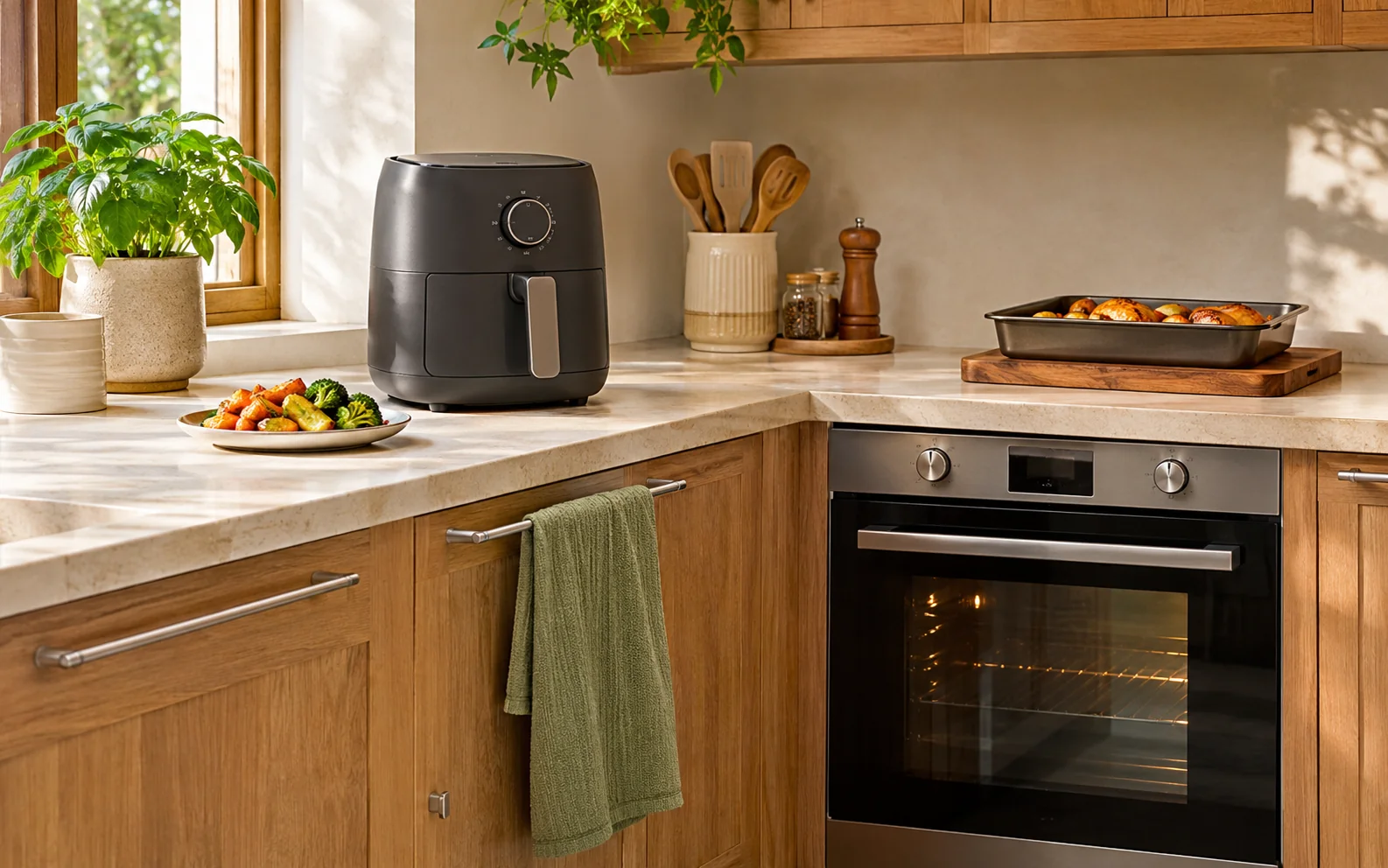
An air fryer usually makes more sense for small, crisp meals; an oven is more versatile for large dishes, baking and several trays. In the air fryer vs oven decision, compare the complete meal, not wattage alone. A smaller appliance can save energy, but repeated batches can remove that advantage.
Reviewed by Live Decor Well · Last reviewed . Source and calculation review; no hands-on product testing or professional certification is claimed.
Inside this story
Manufacturer and retailer links help verify specifications and prices. This guide is based on research, not hands-on product testing.
Air fryer vs oven: what is the practical difference?
An air fryer is a compact fan-assisted cooker that moves hot air around a relatively small food basket. A full-size oven provides a larger cooking space and usually more shelf positions. The useful difference is how much food you can spread out, which cookware fits and how many dishes cook together.
Think about a normal evening rather than a marketing photograph. Two portions of potatoes may fit comfortably in a basket, while a wide roasting dish needs a conventional oven. A tall basket is not necessarily a generous cooking surface: stacking food changes how freely hot air can reach it. The stated capacity therefore needs a second check against the shape of your usual meal.
The table is a planning comparison, not a performance test. Individual appliances overlap: countertop oven-style air fryers can accept trays, while full ovens may include an air-fry mode. Neither label guarantees that your existing dish fits.
| Question | Basket air fryer | Full-size oven |
|---|---|---|
| Small portions | Often a convenient fit | May heat more space than needed |
| Large roasting dish | Check basket dimensions | Usually the more practical format |
| Several trays | May require batches | Multiple shelf positions |
| Counter space | Needs a safe working position | Built into cabinetry or a range |
| Cleaning | Basket and drawer after use | Shelves, trays and cavity |
Does an air fryer use less electricity than an oven?
An air fryer can use less electricity for a small meal because it heats a smaller cavity and may finish sooner. Rated watts alone cannot tell you the saving. Total energy depends on operating time, heater cycling, preheating and how many batches are needed to feed everyone at the same sitting.
For a concrete rating, the Ninja AF100-series owner’s guide lists 1,550 watts. Bosch lists a 2,800-watt connection rating for the UK HQA534BB3B oven in its technical specifications. These are appliance ratings, not measured energy use for matching recipes. Dual-basket air fryers can also draw more than a small single-basket model.
The Energy Saving Trust’s cooking comparison emphasizes matching the appliance to the amount of food. A full oven can be sensible when several dishes cook together. Counting one air-fryer batch against an entire oven meal would produce a misleading comparison.
How do you calculate air fryer vs oven energy cost?
Calculate cooking cost by multiplying energy used in kilowatt-hours by your electricity rate per kilowatt-hour. If you only have the rated power, watts divided by 1,000 and multiplied by hours gives a continuous-power scenario. It is useful for arithmetic, but thermostat cycling means it is not a measured bill prediction.
Here is an explicit illustration: a 1,500-watt appliance running continuously for 20 minutes uses 0.50 kWh. A 2,500-watt appliance running continuously for 45 minutes uses 1.875 kWh. These are hypothetical schedules, including whatever preheating you put inside those times; they are not test results or guaranteed times for the same food.
Use the unit rate on your own bill. The three rates below are deliberately illustrative local tariffs, not currency conversions or national averages. A fixed daily standing charge is not added to one cooking session because changing the appliance usually does not change that charge.
| Scenario | Energy | US$0.20/kWh | £0.25/kWh | A$0.30/kWh |
|---|---|---|---|---|
| 1.5 kW × 20 minutes | 0.500 kWh | US$0.10 | £0.13 | A$0.15 |
| 2.5 kW × 45 minutes | 1.875 kWh | US$0.38 | £0.47 | A$0.56 |
| Three 20-minute small-appliance batches | 1.500 kWh | US$0.30 | £0.38 | A$0.45 |
Is an air fryer always faster than an oven?
An air fryer can shorten the wait for a small quantity, but the relevant time is when the whole meal is ready. Include preheating, loading, shaking, turning and additional batches. A large oven that finishes several dishes together may be faster overall than a basket that needs to be emptied and refilled.
Do not build the comparison around a universal three-minute versus fifteen-minute preheat claim. Appliance size, target temperature and cooking mode change the wait. Follow the manual and recipe, and record the actual time for a meal you cook often. If an oven is already hot from another dish, charging it a second full preheat would distort the result.
For a fair home comparison, keep the portion size, starting food temperature and desired finish consistent. Note total elapsed time as well as the appliance setting. A crisp outside does not by itself establish that the inside is adequately cooked; follow food-specific cooking guidance rather than judging only by appearance.
Can an air fryer replace an oven for a family?
An air fryer can replace some oven jobs, but it is a less complete replacement when your meals rely on large pans or several dishes. Compare the usable basket footprint with your cookware, then count batches. A household that bakes, entertains or cooks differently sized portions may still need the larger oven.
Make a short list: the dish used for pasta bake, your regular roasting tray, a cake tin and whatever you prepare for guests. Measure their outside dimensions, including handles. For example, a 13×9-inch (33×23 cm) pan needs a clear opening larger than those numbers; advertised basket volume does not prove that it fits.
If the air fryer handles the side dish while the oven cooks the main course, you gain flexibility rather than necessarily reducing total electricity. That can still be worthwhile. For a renovation, our size-led wall oven guide helps compare built-in options without assuming that every kitchen needs the largest cavity.
How much kitchen counter space should you allow?
An air fryer needs more room than its closed footprint: allow the manufacturer’s ventilation clearance and space to remove the basket safely. An oven needs its specified cabinet opening, support and door clearance. Neither should be chosen from a width measurement alone; sketch how it works when the appliance is actually open.
Use a cardboard footprint on the worktop before buying. Mark the drawer’s operating path and where the hot basket will rest. Check that the power cord can reach an appropriate outlet without trailing across a sink or the front of a cooking surface. A cupboard that hides an appliance for storage may be unsuitable for running it.
For a narrow kitchen, keep the preparation area continuous instead of scattering appliances across every available surface. Move rarely used items out of the working zone first. Our open shelving kitchen ideas can help organize everyday crockery, but do not turn a decorative shelf into an improvised hot-appliance station.
Is buying an air fryer worth the extra cost?
Buying an air fryer makes financial sense only if the meals you move into it save enough to justify the purchase and the space it occupies. Start with the price difference and realistic use frequency. Convenience may be a valid reason to buy, but it should not be presented as guaranteed electricity savings.
For a simple payback illustration, suppose the appliance costs US$100 (£80 / A$150) and saves US$0.15 (£0.12 / A$0.22) each time you use it instead of an oven. It would take about 667 uses to recover the purchase price before considering repairs or replacement. That is a calculation from assumed inputs, not a forecast for a particular model. Currency comparisons use explicit planning assumptions of US$1 = £0.80 = A$1.50, not live exchange rates or equivalent local retail prices. Taxes, delivery and installation may differ.
Compare the same regional model and included accessories. US shoppers can check manufacturer stores and Home Depot; UK shoppers can compare John Lewis or Argos with the brand’s own listing. Canadian, Australian and New Zealand buyers should use local stockists and voltage-compatible models, not assume a US listing is suitable for import. Check replacement baskets and cleaning instructions as well as the sale price.
What safety checks matter for either appliance?
Keep both appliances installed and operated as their manufacturers specify, with clear ventilation and an appropriate electrical supply. Portable appliances and built-in ovens have different installation requirements. Check the exact regional model and instructions; a travel adaptor or a matching-looking plug does not establish that an imported appliance is suitable.
Electrical Safety First’s air-fryer guidance advises against overfilling and stresses cable placement, cleaning and supervision. In the US, follow the appliance listing and installation instructions plus locally adopted electrical requirements. In the UK, fixed electrical work should be assessed against the applicable BS 7671 requirements by a competent installer; that is separate from choosing a cooking mode.
This is not a wiring guide. Keep hot appliances away from decorative fabric and loose paper, and follow the manual before adding liners or accessories. Design decisions such as paint color and shelving come after the usable cooking area is established; our kitchen paint planning calculator handles material estimates for the surrounding refresh.
Which should you choose: air fryer or oven?
Choose the air fryer when your regular meals fit in a small basket and you have a safe, convenient counter position. Choose the oven when pan size, baking or simultaneous dishes matter more. Keeping both is reasonable when they serve different jobs, but duplicate functions alone are not a reason to buy another appliance.
Before ordering, test the decision on three meals from your real week: one quick dinner, one batch-cooking session and one meal for guests. Write down the number of pans, cooking temperatures and portions. That small exercise is more revealing than comparing maximum advertised capacities or counting the number of presets on a display.
Frequently Asked Questions
You Might Also Love
Best Wall Oven Choices for Your Kitchen in
The best wall oven is the one that fits your cabinet, electrical supply, cookware and cooking routine. Start with the installation drawing, then compare controls and useful features. This research-based shortlist covers compact and larger US formats plus UK and Australian options; it is not a hands-on cooking-performance ranking.
30 Open Shelving Kitchen Ideas
Transform your kitchen with these 30 open shelving ideas. Sage green, farmhouse, modern and budget-friendly floating shelf inspiration for 2026.
25 Navy Blue Kitchen Ideas
Stunning navy blue kitchen cabinet ideas with brass hardware, marble countertops and island designs. Bold kitchen inspiration for a dramatic 2026 makeover.